

Jamaat-e-Islami Leader Urges Iran to Join Makkah Pact
At a glance
- Pakistan, Saudi Arabia, and Türkiye signed the Makkah Joint Defence Agreement.
- A Jamaat-e-Islami leader has called for Iran to join the pact.
- The agreement is described as purely defensive and open to other regional countries.
Story so far
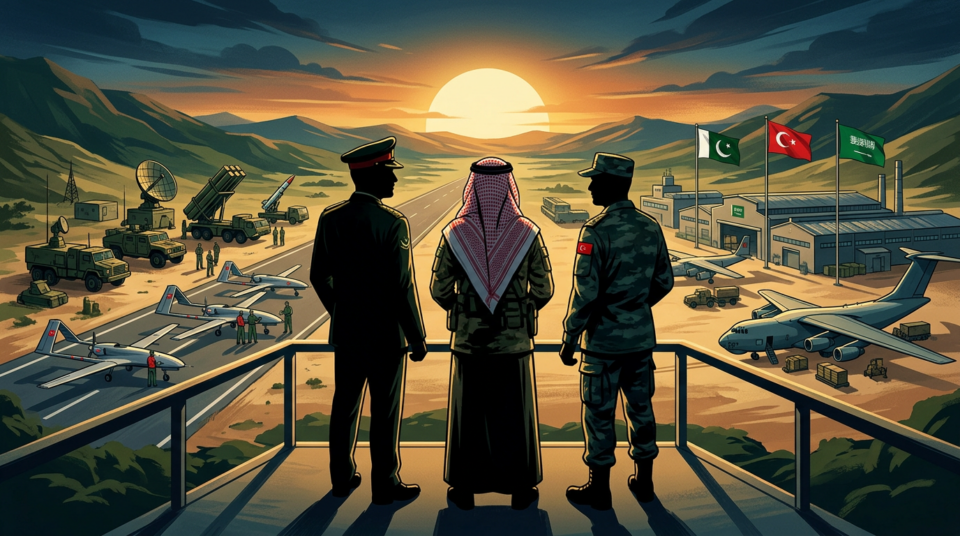
Pakistan, Saudi Arabia, and Türkiye have formally signed the Makkah Joint Defence Agreement, establishing a collective security framework. The pact, described as purely defensive and not targeted against any country, considers an armed attack on one signatory as an attack on all, similar to NATO's Article 5. Deputy Prime Minister and Foreign Minister Ishaq Dar clarified its scope, emphasizing its aim to strengthen strategic cooperation for regional peace and stability. Turkish Foreign Minister Hakan Fidan confirmed it is open to other regional countries, with Egypt potentially joining, and noted that a ministerial committee and a General Secretariat will be established in Saudi Arabia. Amidst these developments, a leader from Jamaat-e-Islami has publicly called for Iran to join the agreement.
Latest development
A leader from Jamaat-e-Islami has publicly called for Iran to join the recently signed Makkah Joint Defence Agreement.
Latest updates
A leader from Jamaat-e-Islami has publicly called for Iran to join the recently signed Makkah Joint Defence Agreement.
Deputy Prime Minister and Foreign Minister Ishaq Dar stated on Sunday, August 9, 2026, that the Makkah Joint Defence Agreement is open to other countries prepared to adhere to its basic principles. He emphasized that the arrangement is defensive and seeks to support peace, stability, and prosperity across the region. The pact, signed by Pakistan, Saudi Arabia, and Türkiye on Friday, August 7, at the Makkah Al-Mukarramah Summit for Joint Defence, establishes a collective security mechanism under which an armed assault on one signatory would be treated as an attack on all three. Dar clarified that the accord does not cancel or alter any existing agreements and is consistent with Article 51 of the United Nations Charter.
Deputy Prime Minister and Foreign Minister Ishaq Dar clarified the scope and intent of the recently signed “Makkah Joint Defence Agreement” on Sunday, August 9, 2026. In a post on X, Dar stated that the agreement, signed jointly by Pakistan, Saudi Arabia, and Turkiye in Makkah Mukarramah on Friday, reflected the depth of brotherly relations between the leadership and peoples of the three countries. He added that the accord was the culmination of years of discussions and coordination, driven by a shared desire to strengthen strategic cooperation in addressing peace and security challenges and to advance regional peace, stability, and prosperity. Dar further stressed that the Makkah Accord did not abrogate or replace any existing bilateral or multilateral agreements and that any external armed attack on one of the three countries would be considered an attack on all three, consistent with the inherent right of individual and collective self-defence under Article 51 of the UN Charter.
Deputy Prime Minister and Foreign Minister Dar stated on Sunday that the defence pact signed between Pakistan, Saudi Arabia, and Turkiye is "purely defensive" and remains "open to any country in the region" willing to uphold its fundamental principles. This clarification follows earlier indications that Egypt could join the pact once technical issues are resolved.
Turkish Foreign Minister Hakan Fidan further elaborated on the expansion model, noting that while other countries have expressed interest, the founding members—Turkiye, Saudi Arabia, and Pakistan—will remain the core countries responsible for establishing the alliance's principles, standards, and long-term structure. Other nations can join with the approval of these core members. Fidan emphasized the vision for the alliance to grow beyond its initial three members and highlighted that Pakistan's participation extends the initiative beyond the traditional definition of the Middle East, representing a broader regional perspective. Meanwhile, Islamabad has been decorated for a major event related to this agreement, signaling ongoing developments.
Amidst the ongoing discussions surrounding the Makkah Defence Pact, suggestions have emerged that Iran should also be included in the trilateral agreement. Meanwhile, reports indicate that celebrations are taking place across Pakistan in response to the formation of the pact, which is being viewed as a significant step towards unity and cooperation among Muslim countries.
Turkish Foreign Minister Hakan Fidan has stated that the trilateral defence agreement between Turkey, Pakistan, and Saudi Arabia is based on the principle of NATO's Article 5. He further elaborated that a ministerial committee and a General Secretariat, modelled after NATO, will be established, with the General Secretariat to be located in Saudi Arabia. The Foreign Minister also indicated that Egypt might join the alliance once technical issues are resolved.
Turkish Foreign Minister Hakan Fidan has confirmed that the trilateral defence agreement involving Pakistan, Saudi Arabia, and Turkey is not directed against Iran.
Turkey has issued a clarification stating that the trilateral defence agreement with Pakistan and Saudi Arabia is not directed against Iran.
Latest Fact Checks
Makkah Defence Pact Open to Other Countries, Says Ishaq Dar
Deputy Prime Minister and Foreign Minister Ishaq Dar said on Sunday that the Makkah Joint Defence Agreement is open to…
مکہ مشترکہ دفاعی معاہدہ مکمل طور پر دفاعی نوعیت کا ہے: اسحاق ڈار کی وضاحت
اسلام آباد: نائب وزیراعظم و وزیر خارجہ محمد اسحاق ڈار نے پاکستان، سعودی عرب اور ترکیہ کے درمیان طے پانے والے مکہ مشترکہ دفاعی معاہدے کے حوالے سے اہم وضاحت جاری کرتے ہوئے کہا ہے کہ معاہدہ کسی ملک کے خلاف نہیں بلکہ خطے میں امن، استحکام اور خوشحالی کے ل


Responses