

US vows ‘unprecedented’ pressure to seek end of Iranian government
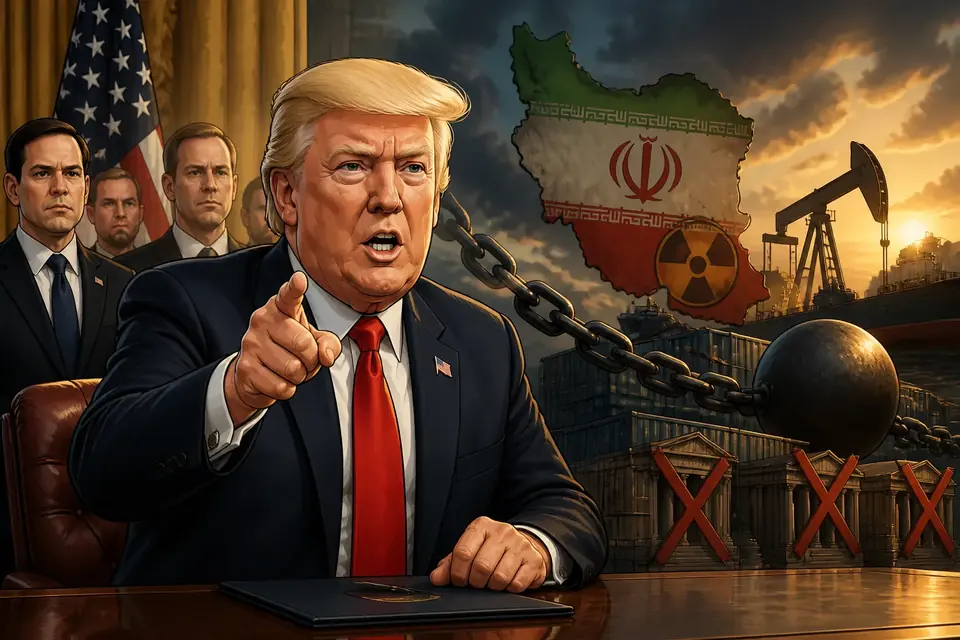
At a glance
- US Treasury Secretary Scott Bessent announced the 'harshest sanctions in history' against Iran.
- Bessent stated the goal is to end the current Iranian government via an 'economic blockade'.
- Iran has warned its response to new US threats will be 'devastating'.
Story so far
The United States announced a new campaign of severe sanctions against Iran, which Tehran met with threats of a "devastating" response. US Treasury Secretary Scott Bessent said the measures would be the "harshest in history," while Iran's military warned it was prepared for a confrontation.
Latest development
US Treasury Secretary Scott Bessent has reportedly declared the aim of new sanctions is to end the current Iranian government, describing the measures as a "major economic blockade" and urging allies to sever ties with Tehran.
Latest updates
In a significant escalation of rhetoric, US Treasury Secretary Scott Bessent has stated that the goal of new sanctions is to apply unprecedented economic pressure to bring about an end to the current Iranian government. According to reports from Washington, Bessent described the plan as a "major economic blockade" and urged allies and the international community to sever all ties with Tehran's government.
Responding to Washington's pledge to impose its harshest-ever sanctions, Iran said on Friday its response to any new threats would be “devastating.”
The chief of staff of Iran’s Armed Forces, Major General Ali Abdollahi, was quoted by Iranian media as saying the Islamic Republic’s reaction would be “crushing, punishing and devastating.” He stated that Iran's forces were prepared across land, sea, air, and cyberspace.
Meanwhile, Iran’s parliament speaker, Mohammad Baqer Qalibaf, accused the U.S. and Israel of resorting to economic and “cognitive” warfare. The comments came after U.S. Treasury chief Scott Bessent announced he would provide details of the new sanctions on Monday, which are aimed at toppling the Iranian leadership.
Iran has issued a response to the new sanctions announced by the United States, according to available reports on Friday, August 21. The specific details of Tehran's response have not yet been made public.
Pakistan News will update this story as more confirmed details become available.
The United States has provided further details on its new sanctions against Iran, with Treasury Secretary Scott Bessent describing them as the "harshest in history" and warning that countries doing business with Tehran will also face American measures.
In an interview with US media on Friday, Bessent said the new sanctions aim to limit the Iranian government's proxy activities and that further announcements should be expected next week. He stated the goal is to "end the Iranian government" through economic pressure.
The Treasury Secretary explained that the measures would combine intensified economic pressure with a continued blockade of the Strait of Hormuz, preventing any goods from entering or leaving Iranian ports. "It will be a combination of economic isolation for Iran and the ongoing blockade in the Strait of Hormuz, the likes of which the world has never seen before," he said.
Bessent added that all countries, including China, want to see the Strait of Hormuz reopened.
The United States has announced a sweeping new sanctions campaign against Iran, according to reports on Friday.
The move formalises threats made earlier by US President Donald Trump of "economic warfare and isolation on an unprecedented scale" against Tehran. The US Treasury Department is expected to release further details of the measures.
Oil prices rose to a more than three-week high on Thursday after US President Donald Trump warned of retaliation against nations supporting Iran. Brent crude futures increased by 2.1% to $93.56 a barrel, while US West Texas Intermediate crude futures rose by 2.5% to $88.01 a barrel, both marking their highest levels since July 24.
The price surge followed President Trump's threat of “economic warfare and isolation on an unprecedented scale” against Tehran, with a warning of consequences for any country that provided “any type of lifeline to Iran.”
The United Arab Emirates also suspended all financial and economic transactions with Iran earlier in the week. Analysts noted that the threats against nations assisting Iran could become a sensitive issue for China, the largest importer of Iranian crude oil.
US Treasury Secretary Scott Bessent clarified on Thursday that the planned economic measures against Iran are intended to lessen the need for new major military operations. “If we are doing the maximum economic pressure, then that means that likely there will not be a large-scale kinetic restart,” he told CNBC, using a term for military force.
His comments followed a rise in oil prices to a three-week high after the US threats. Bessent is expected to share more details on Monday.
He described the US strategy as a “one-two punch” involving a naval blockade and sanctions, stating the goal is to “collapse this regime.”
In response, Iran’s foreign ministry condemned the US plans, calling them “economic terrorism” that would target ordinary Iranians and amount to crimes against humanity.
The conflict, which has been ongoing for nearly six months, has seen two ceasefire deals in April and June crumble. It has reportedly led to thousands of deaths and disrupted about a fifth of the world's traded oil that passes through the Strait of Hormuz.
The United States has announced it is preparing what Treasury Secretary Scott Bessent described as the “toughest sanctions in history” against Iran.
The announcement on August 20 adds detail to President Donald Trump's earlier declaration of a new campaign to target Iran's economy, intensifying pressure on Tehran amid the ongoing conflict.
In response to the latest economic pressure from Washington, an Iranian Deputy Foreign Minister has stated that "America is begging allies for help," according to reports on August 20. This statement follows President Donald Trump's announcement of a new campaign targeting Iran's economy.
An analysis of US President Donald Trump's threat to impose "unprecedented economic warfare" on Iran highlights the potential implications for Tehran's key trading partners, including Pakistan.
According to analysts, any US action against countries trading with Iran could be a serious setback for Pakistan, which has a commitment with Iran to expand bilateral trade to $10 billion. While formal trade has been limited by past sanctions, unofficial trade is estimated to be around $4 billion.
China, the biggest buyer of Iranian oil, could also face additional pressure. Reports indicate China has used a system of refiners with little US exposure and has branded Iranian oil as originating from other countries to bypass sanctions. India's trade with Iran has already fallen sharply in recent years, standing at $1.63 billion in the 2025-26 fiscal year.
Following US President Donald Trump's threat of new sanctions against Iran, global crude oil prices rose by over 2% on Thursday. Brent crude futures climbed to nearly $94.06 a barrel, while US West Texas Intermediate (WTI) crude reached $87.67 a barrel.
The price increase comes amid a stalemate in ceasefire talks between the US and Iran and significantly reduced oil transit through the Strait of Hormuz due to the ongoing conflict. Reports noted that the impact of higher energy prices is already being felt in global economies, contributing to rising inflation in the UK and the Eurozone in July.
In his announcement, President Trump did not specify what exact measures would be taken against countries that continue to engage with Iran, nor did he name any particular nations that were being targeted with the warning.
In his statement, President Trump claimed that Iran’s navy had been “eliminated,” its air force “destroyed,” and its military factories “reduced to rubble.” He described the Iranian currency as “worthless” and the country as “hanging by a thread.”
Urging US allies to support the effort, he called the new measures an “Economic D-Day” and reiterated his position that “IRAN WILL NEVER HAVE A NUCLEAR WEAPON.”
In response, Iranian media dismissed the threats. The semi-official Tasnim news agency described the measures as another version of Washington’s failed “maximum pressure” campaign and Trump’s rhetoric as “grand, exaggerated language.” The Fars news agency called the US president's claims “delusional.”
United States President Donald Trump announced his new economic measures against Iran on his social media platform, Truth Social, describing them as the "MOST CRUSHING ECONOMIC OPERATION EVER TAKEN AGAINST ANY COUNTRY!".
He specified several activities that he said must stop immediately, including "oil smuggling, swap lines, cash transfers, exchange houses, ship registries, front companies".
The move comes nearly six months into a conflict that began on February 28 with US-Israeli attacks on Iran, which has severely disrupted shipping in the Strait of Hormuz. Two previous ceasefire agreements in April and June have collapsed.
The US Treasury has been conducting a campaign dubbed "Operation Economic Fury" to cut off Iran's funding. Last week, Treasury Secretary Scott Bessent said the US would ramp up efforts for economic isolation as part of a two-pronged approach with a US naval blockade.
In response to the developments, Mohammad Mokhber, an adviser to Iran's supreme leader, stated that Iran remains open to dialogue but does not confuse negotiations with surrender.
Latest Fact Checks
ایران پر سخت پابندیاں لگا کر حکومت کا خاتمہ کیا جائے گا: امریکی وزیر خزانہ کا اعلان
واشنگٹن: امریکی وزیر خزانہ اسکاٹ بیسنٹ نے ایران کے خلاف سخت ترین معاشی اقدامات کا اعلان کرتے ہوئے تہران پر غیر معمولی معاشی دباؤ بڑھانے کا عندیہ دے دیا ہے۔
Iran vows 'devastating' response as US threatens toughest ever economic hit
DUBAI/WASHINGTON: Iran said on Friday that its response to any new U.S. threats would be “devastating” after Washington pledged to impose the toughest financial penalties in history with the aim of toppling the Iranian leadership. U.S. Treasury chief
امریکا کا ایران کیساتھ کاروبار کرنے والے ممالک کیخلاف بھی سخت اقدامات کا اعلان
امریکا نے ایران پر تاریخ کی سخت ترین پابندیاں عائد کرنے کا اعلان کر دیا۔
Oil hits more than three-week high
NEW YORK: Oil prices rose to more than a three-week high on Thursday after US President Donald Trump warned of retaliation against nations supporting Iran, his latest attempt to resolve a war that has stranded millions of barrels of Middle Eastern oi
US will impose ‘toughest sanctions in history’ on Iran: Bessent
WASHINGTON/DUBAI: The US will impose “the toughest sanctions in history” on Iran, Treasury Secretary Scott Bessent said on Thursday, a focus on economic measures he suggested would lessen the need for new major military operations against Tehran. His
Trump threatens to isolate Iran. Who are its trading partners?
A threat by US President Donald Trump to impose unprecedented economic warfare and isolation on Iran could have implications for countries that trade with it. Trump warned of economic consequences for any country that supports Iran. Here are some of
ٹرمپ کی ایران کو اقتصادی جنگ کی دھمکی؛ عالمی منڈی میں پیٹرول مزید مہنگا ہوگیا
امریکی صدر ڈونلڈ ٹرمپ کی ایران کے خلاف مزید سخت اقتصادی پابندیوں کی دھمکی کے بعد عالمی منڈی میں خام تیل کی قیمتیں مزید 2 فیصد بڑھ گئیں۔
امریکی صدر ٹرمپ کا ایران کیخلاف تباہ کن معاشی پابندیوں کا اعلان
امریکی صدر ڈونلڈ ٹرمپ نے ایران کے خلاف تباہ کن معاشی پابندیوں کا اعلان کر دیا۔
Trump warns countries helping Iran of ‘tremendous economic consequences’
WASHINGTON – US President Donald Trump has warned that countries providing financial, commercial or other support to Iran could face…
'Tremendous consequences': Trump threatens economic punishment on 'any country' helping Iran
United States President Donald Trump said on Wednesday he was launching a major new campaign to target Iran’s economy, threatening “tremendous” punishment on any country that helps or does business with the country. The intensified economic pressure
Trump warns of economic consequences for any country that supports Iran
WASHINGTON/DUBAI: US President Donald Trump warned of economic consequences against any country that provided “any type of lifeline to Iran” as the US looks to resolve a war it began alongside Israel nearly six months ago. Thousands of people have


Responses