

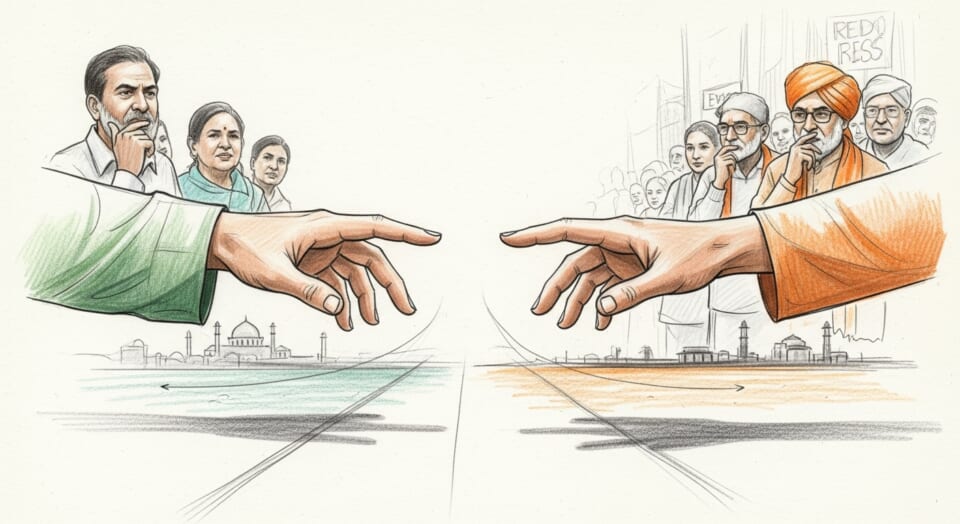
Reports emerge regarding potential Pakistan-India peace talks
Prime Minister Shehbaz Sharif held a telephonic conversation with his Qatari counterpart, Sheikh Mohammed bin Abdulrahman bin Jassim al Thani, on Sunday, thanking him for Qatar’s strong endorsement of Pakistan-led diplomatic initiatives. According to a statement, the two leaders exchanged views on the evolving regional and international situation, with the prime minister expressing deep appreciation for Qatar’s constructive role in regional diplomacy and mediation efforts.
Both leaders agreed on the need for continued close coordination to address common challenges. The call underscores Pakistan’s ongoing engagement in efforts for de-escalation between the United States and Iran, following a conflict that began with US-Israeli strikes on Iran in late February. Hostilities have largely ceased since a Pakistan-brokered ceasefire was agreed upon on April 8.
Following the ceasefire, a first round of historic direct US-Iran talks was held in Islamabad on April 11 and 12, with Pakistan playing a mediating role. While those talks concluded without a final agreement, they did not result in a breakdown of the process. Islamabad has since continued its efforts to convene a second round.
As part of this continued shuttle diplomacy, Interior Minister Mohsin Naqvi recently concluded an unscheduled visit to Iran. During the trip, he held meetings with Iranian President Masoud Pezeshkian and Parliament Speaker Bagher Ghalibaf. While officially framed around bilateral and border security cooperation, diplomatic sources indicate the visit was aimed at reviving the stalled Iran-US peace process.
The sources stated the trip was intended to prevent the negotiations from collapsing entirely after momentum slowed, particularly following President Donald Trump’s rejection of Tehran’s latest response to American proposals. These diplomatic maneuvers come as the fragile ceasefire holds unevenly amid intermittent tensions around the Strait of Hormuz, which have caused prolonged disruption to global energy shipping.
 Latest Updates
Updated: 10:19 PM PKT — May 17, 2026
Pakistan has expressed “utmost satisfaction” over a supplemental award by the Permanent Court of Arbitration (PCA), affirming Islamabad’s position that the Indus Waters Treaty (IWT) places substantive limits on India’s water-control projects on the western rivers.
A government statement announced that the decision, issued on May 15, addresses design disputes concerning India’s Ratle and Kishenganga hydroelectric plants in occupied Kashmir. The award focuses on the maximum pondage, or the volume of water that can be stored in a reservoir. Although the PCA has not yet publicly shared the decision, it was communicated to the Indus water commissioners of both nations.
The award validates Pakistan’s central argument that the treaty’s limitations are not mere formalities but must be applied during the planning and design stages of any project. According to the statement, these limits cannot be satisfied simply by a later assurance of operational restraint. The ruling specifies that pondage for a run-of-the-river plant must be justified by genuine project needs, site hydrology, power-system requirements, and other technical data required under the treaty.
Pakistan initiated the arbitral proceedings against India in 2016. India has since boycotted the proceedings, but the court continues to share procedural updates and decisions with both parties. The dispute is rooted in the 1960 Indus Waters Treaty, a World Bank-brokered agreement that allocates the waters of the three western rivers—Indus, Jhelum, and Chenab—largely to Pakistan, while India has rights over the three eastern rivers.
Tensions over the treaty have persisted. In April 2025, India announced a unilateral suspension of its IWT obligations following a deadly attack on tourists in Pahalgam, which New Delhi blamed on Islamabad. However, in a previous supplemental award in June 2015, the PCA had ruled that India cannot unilaterally hold the treaty in abeyance.
[activity-stream-raw include=”9089,8895,8809,8802,8793,8381″ per_page=20 display_comments=0 sort=DESC]


Reactions and comments