

Pakistan’s Clean Energy Focus Shifts to Local Industry Growth
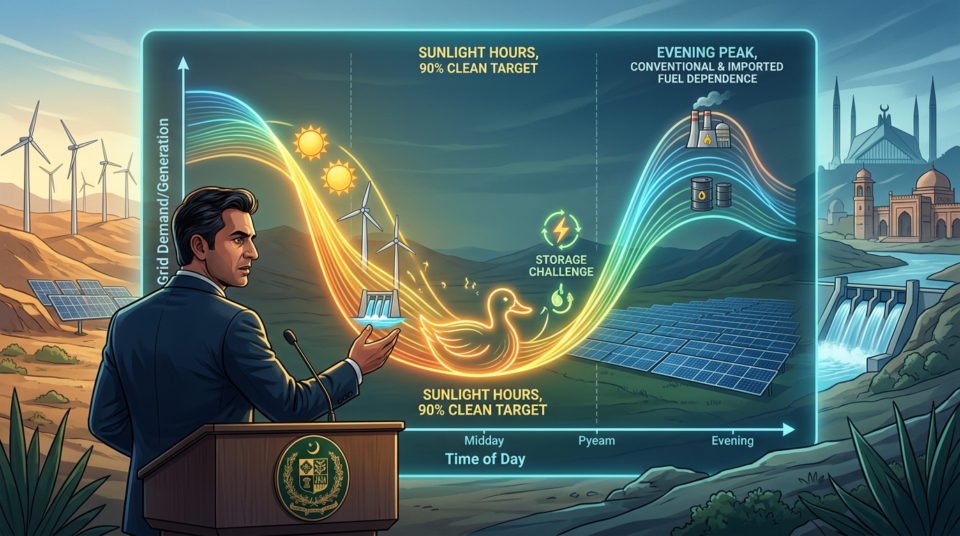
At a glance
- Pakistan aims for 90% clean energy in its power generation by 2035.
- The country's next challenge is to develop local manufacturing and innovation in the clean energy sector.
- Pakistan has become a significant player in consumer-led solar adoption, importing many panels.
Story so far
Federal Minister for Energy Awais Leghari announced Pakistan's ambitious goal to increase clean energy's share in total power generation to 90% by 2035, up from the current 55%. This transformation is driven by a "people-led energy transition," with millions of households, farmers, and businesses installing their own power sources, leading to a daytime energy surplus. However, this has created a "flexibility problem" and a "duck curve" phenomenon, where the national grid struggles to manage the influx of electricity from rooftop solar, resulting in falling daytime demand and high evening demand. The focus is now on shifting surplus mid-day solar energy to meet evening peak demand. Experts at the "Solar, Storage and Flexibility Conference" emphasized that the next challenge is to develop local manufacturing, investment, and innovation in the clean energy sector, as much of the economic value currently flows overseas due to imported components. Pakistan's solar capacity has reached 38,000 megawatts, and battery energy storage systems are deemed crucial for grid stability and achieving the clean energy target.
Latest development
Experts at the "Solar, Storage and Flexibility Conference" highlighted that Pakistan's next energy challenge is to foster local industries, investment, manufacturing, and innovation within the clean energy transition, moving beyond just rooftop solar adoption. They noted that despite a large consumer-led solar market, significant economic value still flows overseas due to imports of components like panels and batteries.
Latest updates
Experts at the "Solar, Storage and Flexibility Conference" stated that Pakistan’s next energy challenge is to capture the industries, investment, manufacturing, and innovation accompanying the clean energy transition, rather than solely focusing on expanding rooftop solar adoption. They noted that while Pakistan has built one of the world’s largest consumer-led solar markets, much of the economic value, including panels, batteries, inverters, and electric vehicles, continues to be imported. Speakers emphasized the opportunity in developing local manufacturing, strengthening technology transfer, investing in skills, and creating stable policy frameworks. Andrew Chang, CEO of New Energy Nexus, highlighted the need to de-risk technology, build trust, and invest in people for a successful industrial ecosystem. The conference also showcased Pakistan’s growing significance in the global energy transition, with the Global Solar Council's 300 Million Solar Homes campaign presenting Pakistan as an early example of its ambition, noting the country imported more solar panels in the past two years than many countries deployed in a decade.
Federal Minister for Energy Awais Leghari stated that negotiations with the International Monetary Fund (IMF) regarding the provision of cheap electricity at specific times have been ongoing for several months. Speaking at the "Solar, Storage and Flexibility 2026" conference in Islamabad, the minister highlighted that Pakistan's solar power capacity has reached 38,000 megawatts. He emphasized that battery energy storage systems are crucial for electricity transmission, grid stability, and achieving the target of 90% clean energy by 2035. Leghari also mentioned that load shedding was experienced due to affected RLNG supply from Qatar.
Federal Minister for Energy Awais Leghari stated that the International Monetary Fund (IMF) is not allowing Pakistan to provide cheap electricity at specific times. He also reiterated the government's aim to reduce the country's fuel import bill.
Energy experts have reportedly criticized Federal Minister for Energy Awais Leghari's claims regarding Pakistan's energy sector.
Latest Fact Checks
‘Next energy challenge shifts to clean energy industry growth’
ISLAMABAD: Pakistan’s next energy challenge is no longer just expanding rooftop solar adoption, but ensuring the country captures the industries, investment, manufacturing, and innovation that accompany the clean energy transition, experts said on th
آئی ایم ایف ہمیں مخصوص اوقات میں سستی بجلی فراہم کرنے کی اجازت نہیں دے رہا : وزیر توانائی
اسلام آباد (نوائے وقت رپورٹ+ این این آئی) وفاقی وزیر توانائی اویس لغاری نے کہا ہے کہ آئی ایم ایف ہمیں مخصوص اوقات میں سستی بجلی فراہمی کی اجازت نہیں دے رہا۔


Responses