

Iran Sets Strict Terms for US Deal as Post-Ceasefire Talks Begin
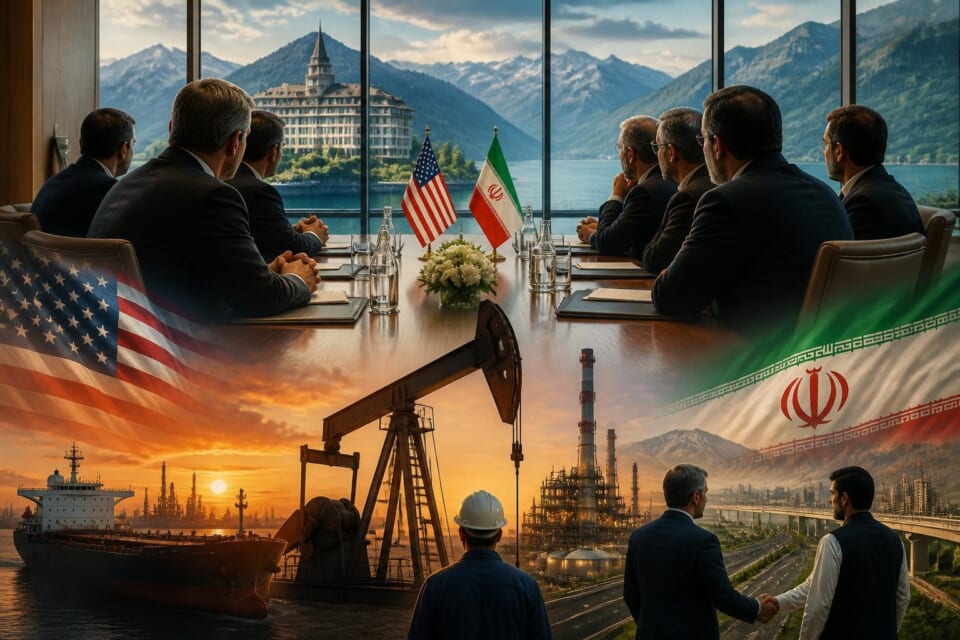
The first direct talks between the United States and Iran since the signing of the Islamabad Memorandum of Understanding have commenced in Bürgenstock, Switzerland. The discussions come as a senior Iranian official warned that Tehran will not accept any agreement that exists only on paper.
Mohammad Mokhbar, an adviser to Iran’s supreme leader, stated that Washington must honour its commitments, asserting that the US responds best to economic pressure. He warned that if any agreement is not properly implemented, energy supplies from the Middle East could face disruption. “Our negotiating team will accept nothing less than complete implementation of commitments and the protection of the nation’s rights,” Mokhbar said.
Underscoring the economic dimension, Iran’s Oil Minister Mohsen Paknejad said the country’s energy sector would serve as a key indicator of whether the agreement is genuinely upheld by Western nations. According to the oil ministry’s news agency, Paknejad highlighted that Iran’s oil industry has prepared hundreds of investment projects and partnership deals, offering major opportunities for international investors in the post-agreement period.
Meanwhile, Pakistan’s role in mediating the conflict has drawn international praise. British Minister Hamish Faulkner commended Pakistan for its crucial part in achieving the ceasefire, describing it as ‘great news’. Faulkner also noted positive signs regarding Pakistan’s budget and expressed encouragement over the country’s development projects and infrastructure improvements.
 Latest Updates
Updated: 6:53 PM PKT — June 21, 2026
High-level technical talks between the United States and Iran have commenced in Bürgenstock, Switzerland, with Pakistan and Qatar serving as mediators. The negotiations follow the electronic signing of a Memorandum of Understanding (EoU) last Thursday and are scheduled to continue for 60 days.
The American delegation is led by Vice President J.D. Vance, accompanied by President Trump’s special envoy Steve Witkoff and Jared Kushner. The Iranian team is headed by Parliament Speaker Baqer Qalibaf and Foreign Minister Abbas Araghchi. Pakistan’s Prime Minister Shehbaz Sharif and Chief of Army Staff Field Marshal Asim Munir are present to facilitate, alongside Qatar’s Prime Minister Sheikh Mohammed bin Abdulrahman Al Thani. Upon arrival at the conference hall, Sharif and Munir welcomed their American and Iranian counterparts.
The talks are overshadowed by ongoing Israeli attacks in Lebanon, which Tehran views as a violation of the EoU’s primary clause for a ceasefire on all fronts. Iran insists that the first day of negotiations must focus on achieving a permanent ceasefire in Lebanon, where Israeli strikes since March have reportedly killed over 4,000 people and displaced more than a million. Iran’s demands also include the end of the US naval blockade, the return of frozen assets, and the lifting of sanctions on its petroleum sector. In response to the alleged ceasefire violations, Iran’s Revolutionary Guards announced on Saturday the re-closure of the Strait of Hormuz, a claim disputed by the US Central Command, which reported increased commercial traffic through the waterway.
While US Vice President Vance expressed a desire for progress on both the Lebanon ceasefire and Iran’s nuclear program, Iranian officials have stated that the nuclear issue is not the initial topic. Tehran’s focus is on Washington’s plan to implement its commitments under the EoU. An advisor to Iran’s Supreme Leader warned that Tehran would not accept a “paper-only” agreement and that energy supplies from the Middle East could be disrupted if promises are not kept. Prime Minister Shehbaz Sharif credited President Donald Trump’s “statesmanlike leadership” for making the negotiations possible and noted Field Marshal Asim Munir’s important role in the process.
Updated: 6:19 PM PKT — June 21, 2026
Pakistan-mediated negotiations between the United States and Iran have commenced in Bürgenstock, Switzerland, aimed at implementing a recent memorandum of understanding. Prime Minister Shehbaz Sharif and Chief of Army Staff Field Marshal Asim Munir are leading the Pakistani delegation, which is set to hold bilateral meetings with representatives from Iran, Qatar, Switzerland, and the US.
Ahead of the talks, Iranian President Masoud Pezeshkian stated that Iran would not abandon its right to uranium enrichment. He claimed the US has made a “180-degree U-turn” from its previous stance and now recognizes Iran’s rights. Pezeshkian confirmed Iran has signed a pledge not to pursue nuclear weapons, a key US demand, which he said aligns with Iran’s established policy.
The Iranian president expressed optimism that the negotiations would yield tangible successes for the Iranian people, noting that the agreement facilitates the return of $6 billion in Iranian funds held in Qatar. He identified Israeli Prime Minister Benjamin Netanyahu as being the most dissatisfied with the diplomatic progress.
Updated: 3:11 PM PKT — June 21, 2026
Iran has announced that the ongoing conflict in Lebanon between Israel and Hezbollah will be a central issue in the ongoing talks with the United States in Switzerland. Foreign Ministry spokesperson Esmaeil Baghaei stated that Tehran considers Israel’s “continued violations of commitments in Lebanon” as the main topic on the agenda, alongside discussions on the release of frozen financial assets and the granting of licenses for Iranian oil sales.
Separately, a senior representative of Iran’s Supreme Leader within the Islamic Revolutionary Guard Corps (IRGC), Hojjatoleslam Abdollah Haji Sadeghi, commented that negotiations are not Tehran’s preferred approach. He asserted that Iran would enter the dialogue with strength and caution, stressing that its “primary path” remains resistance-based action rather than diplomacy alone. He added that Tehran is not concerned about the possibility of the talks failing and did not enter them out of weakness.
Updated: 2:39 PM PKT — June 21, 2026
Top-level peace talks between the United States and Iran have begun at a Swiss resort, led by U.S. Vice President JD Vance and Iranian chief negotiator Mohammad Baqer Qalibaf. The negotiations aim to secure a durable end to the nearly four-month-long war, building on a 60-day ceasefire agreement brokered by Pakistan. Pakistani Prime Minister Shehbaz Sharif and Army Chief Field Marshal Syed Asim Munir have also arrived to join the talks.
The discussions are complicated by fresh tensions after Iran’s Revolutionary Guards declared the Strait of Hormuz closed in response to Israeli strikes in Lebanon, which occurred despite a ceasefire. While the U.S. military reports that commercial shipping continues, the fragile Lebanon truce was further strained by Israeli attacks that reportedly killed 20 people on Saturday. The U.S. delegation, which includes envoys Steve Witkoff and Jared Kushner, hopes to make progress on the nuclear issue and reinforce the Lebanon ceasefire.
[activity-stream-raw include=”65789,65812,65731,65707,65704,65712,65633,65673,65666,65637,65649,65639,65610,65410,65501,65169,65104,64983,64987″ per_page=20 display_comments=0 sort=DESC]


Comments