

Bilawal Bhutto Comments on New Provinces Debate
At a glance
- Discussions continue regarding the creation of new provinces in Pakistan.
- Interior Minister Mohsin Naqvi has advocated for new provinces, facing criticism.
- Bilawal Bhutto has commented on the issue, quoting Mazhar Abbas.
Story so far
Discussions surrounding the potential creation of new provinces in Pakistan continue, with Interior Minister Mohsin Naqvi actively advocating for new administrative units, claiming the current governance system has "collapsed." This proposal, reportedly backed by a military spokesman, has faced widespread criticism from prominent ruling party leaders, including PPP's Sindh Chief Minister Murad Ali Shah, and other political parties. Critics argue that empowering local governments is a more effective solution than creating new provinces and emphasize adherence to the constitutional process. Most recently, during an AJK Jalsa, Bilawal Bhutto reportedly quoted Mazhar Abbas in the ongoing debate.
Latest development
During an AJK Jalsa, Bilawal Bhutto reportedly quoted Mazhar Abbas in the ongoing discussion surrounding the creation of new provinces.
Latest updates
During an AJK Jalsa, Bilawal Bhutto reportedly quoted Mazhar Abbas in the ongoing discussion surrounding the creation of new provinces.
Interior Minister Mohsin Naqvi has recently advocated for the creation of new provinces and administrative units, asserting that the current governance system has "collapsed." This proposal received backing from the military spokesman.
However, Naqvi's suggestion has drawn significant criticism across the political spectrum. Prominent ruling party leaders questioned his statement, and Sindh Chief Minister Murad Ali Shah of the Pakistan Peoples Party (PPP) explicitly rejected the idea of new provinces. Leaders of Awami Tehreek accused the Interior Minister of promoting the division of Sindh. Other political parties argued that an "illegitimate" government lacks the authority to undertake such a move. The Lahore High Court Bar Association also condemned Naqvi's proposal as unconstitutional, with office-bearers stating that those responsible for the existing order's destruction are now proposing a "new system."
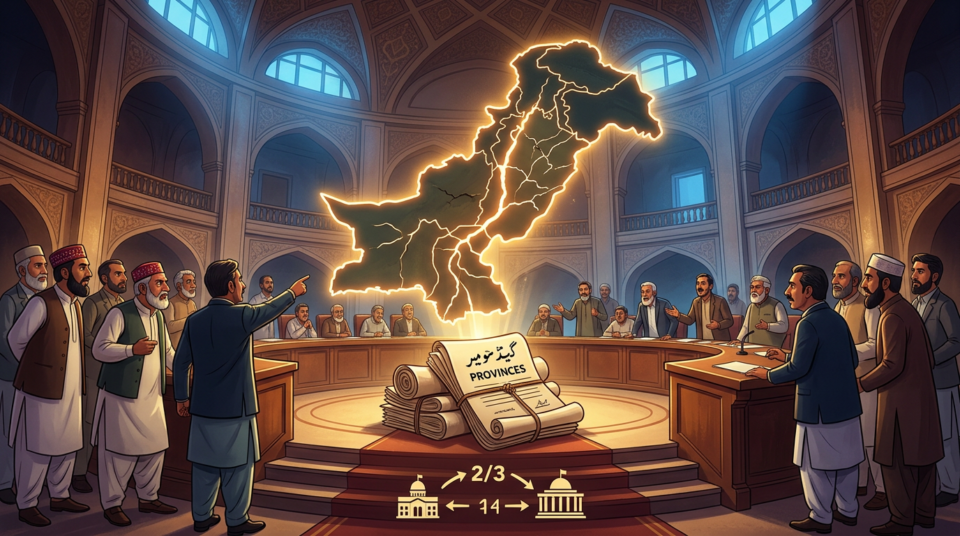
Critics argue that Pakistan's governance crisis is not primarily due to the number or size of its provinces, suggesting that empowering local governments could achieve the goal of bringing administration closer to the people. The Constitution outlines a clear process for provincial changes, requiring a two-thirds majority in the relevant provincial assembly followed by a constitutional amendment with a two-thirds majority in Parliament, a process seemingly bypassed by Naqvi's implied executive approach.
The government views the creation of new provinces as a significant undertaking, with reports indicating it is currently "unprepared" and lacks consensus among political forces. Minister of State for Law and Justice Barrister Aqeel confirmed the government's intention to create new provinces, stating that all political parties would be consulted. Media reports suggest plans for carving out between seven and 27 new provinces. Significant constitutional, legal, and political challenges are anticipated, requiring extensive political consultation. There is speculation that the government may propose constitutional amendments to bypass the requirement for consent from the relevant provincial assembly, as stipulated in Article 239(4) of the Constitution. Such an amendment would necessitate a two-thirds majority in Parliament. Political experts have also suggested a referendum as a possibility, though this too would require parliamentary approval. Pakistan Peoples Party Parliamentarians (PPPP) Secretary General Nayyar Bukhari emphasized that the issue should first be discussed by the federal cabinet before engaging all political parties.
An analysis suggests that Pakistan's governance crisis is fundamentally institutional rather than geographical. While the creation of new provinces might address some concerns related to regional identity, representation, and administrative reach, it cannot solely remedy systemic deficiencies in governance. Without meaningful institutional reform, decentralisation, and fiscal planning, new provinces risk reproducing existing problems at a greater administrative and financial cost.
Modern federal democracies often operate with a three-tier system of governance, distributing constitutional authority among federal, provincial, and elected local governments. The principle is that decisions should be made at the lowest level capable of addressing them effectively. Pakistan's Constitution, specifically Article 140A, already mandates provinces to establish local governments and devolve political, administrative, and financial responsibility to elected local representatives. The challenge lies in the failure to implement this framework meaningfully, as local governments have frequently been weakened, dissolved, or deprived of financial autonomy, with power concentrated at the provincial level.
Amidst the ongoing debate, it has been highlighted that approximately 30 million people are facing a governance crisis, underscoring the urgency for potential administrative reforms. Additionally, Mohsin Naqvi has reportedly received a new suggestion concerning the formation of new provinces.
Reports indicate that Karachi residents are expressing support for the creation of new provinces in Pakistan, reflecting a significant public reaction to the ongoing debate.
Journalist Najam Sethi has commented on the ongoing debate surrounding the potential creation of new provinces, discussing whether it constitutes a political battle and addressing concerns about the possible division of Sindh.
The debate surrounding the creation of new provinces in Pakistan has seen fresh statements from political figures. Huzaifa Rehman of the Pakistan Muslim League-Nawaz (PML-N) stated that the party has never opposed the formation of new provinces. Additionally, Taimur Jhagra has spoken on the matter, contributing to the ongoing discussion. Muhammad Zubair also provided an analysis, emphasizing the importance of Karachi, stating, “If Karachi Falls Behind, Pakistan Falls Behind” in the context of the new provinces issue.
Mohsin Naqvi has reportedly made a controversial statement concerning the formation of new provinces. This development comes amidst ongoing discussions and various political stances on the issue.
Syed Hassan Murtaza has stated that weakening the provinces would weaken the federation. Separately, Hassan Nisar has commented that creating new provinces is not an easy process.
Discussions have emerged regarding the Pakistan Muslim League-Nawaz (PML-N)'s potential support for the creation of new provinces.
Jam Kamal has expressed support for the creation of new provinces in Pakistan, adding to the ongoing political discourse on administrative units.
The renewed debate over creating more provinces in Pakistan reflects genuine public frustration with weak services, distant decision-making, and unequal development. Commentary suggests that before redrawing provincial boundaries, Pakistan must identify which parts of the system have failed, why they failed, and how a new structure would prevent the same weaknesses from returning.
The analysis indicates that failure is not one-dimensional, potentially stemming from political governance, administrative performance, or institutional imbalance. While valid arguments exist for creating new provinces to improve representation and access to services, a new province would not automatically be better governed if underlying issues like political interference, centralized bureaucracy, and weak accountability persist. Concerns are visible in the existing system, where local government elections are often delayed, local bodies remain financially dependent on provincial governments, and municipal institutions frequently lack control over staff and budgets. Provinces demand greater autonomy from Islamabad but are often reluctant to transfer meaningful authority to districts, cities, and communities, highlighting a contradiction at the heart of Pakistan’s decentralization problem.
The Pakistan Bar Council (PBC) on Friday stated that the creation of new provinces should be considered in accordance with constitutional principles and procedures. During a meeting in Islamabad, the PBC reaffirmed the legal fraternity’s commitment to upholding the Constitution, emphasizing that all constitutional matters must be addressed strictly within the constitutional framework. Members were of the unanimous view that the question of creating new provinces should be considered in accordance with constitutional principles and procedures. They stressed the importance of all political parties engaging in comprehensive dialogue for the betterment of the country and its people. The Council resolved that if new provinces are deemed necessary, the process must strictly follow the Constitution through due parliamentary process and national consensus.
Latest Fact Checks
Governance failures
AN effort is underway to spark a debate on creating new administrative units in the country ostensibly on the grounds that the present system is not delivering. Interior Minister Mohsin Naqvi, whose proximity to the establishment is well known, tried
Plan for new provinces faces political minefield
CARVING out new provinces appears to be a gigantic task for the government, one for which the incumbent setup seems “unprepared”, and has yet to build consensus among the country’s political forces. Political parties, meanwhile, have urged the govern


Responses