

PPP’s Shazia Marri rejects new Sindh province, details alternative plan
At a glance
- PPP's Shazia Marri reiterates opposition to a new province in Sindh.
- Coalition partners PML-N, PPP, and MQM-P hold differing views on the issue.
- Proposals include a constitutional amendment or strengthening local governments.
Story so far
The debate over creating new provinces in Pakistan continues, with friction among ruling coalition partners. The MQM-P advocates for new administrative units, while senior leaders from the PML-N and PPP have voiced opposition, particularly concerning the division of Sindh. PPP's Shazia Marri has now reiterated this stance, proposing strengthening local governments as an alternative. Previously, PML-N's Rana Sanaullah denied any discussions with the establishment on the matter, while the PPP has consistently called for a broad national consensus before any such move is made.
Latest development
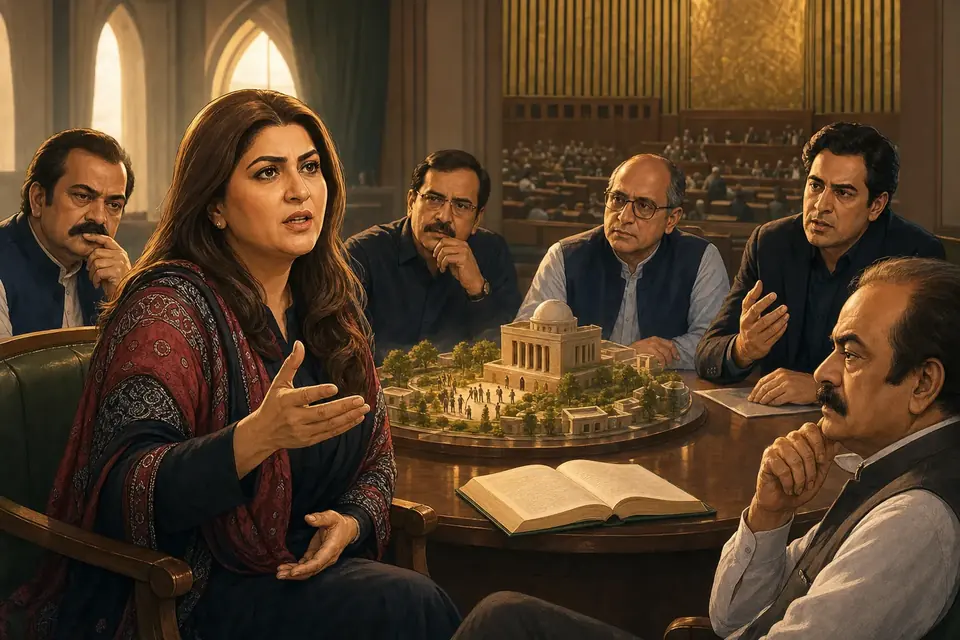
PPP leader Shazia Marri has publicly rejected the idea of creating a new province in Sindh, outlining her party's alternative plan which focuses on empowering local governments.
Latest updates
Adding to the political discourse on the creation of new provinces, Pakistan Peoples Party leader Shazia Marri on August 18 reiterated her party's opposition to any division of Sindh. Marri explained the PPP’s alternative proposal, which focuses on strengthening existing local governance structures rather than creating new provincial units.
On August 17, senior political figure Rana Sanaullah stated that the government has not held any discussions with the establishment regarding the creation of new provinces. His comments add another dimension to the ongoing national debate on the matter.
The political discussion around the creation of new provinces continued on August 17, with leaders from coalition partner PPP offering nuanced views. PPP leader Syed Hassan Murtaza stated that new provinces should be formed with national consensus. This comes amid ongoing friction between the PPP and MQM-P, highlighted by a public exchange between PPP's Qadir Mandokhail and MQM's Mustafa Kamal over the issue. Reports also suggest that discussions are taking place regarding the procedural and constitutional steps required, including a potential 28th Amendment.
The political debate over creating new provinces has seen key leaders from the ruling coalition partners, PML-N and PPP, publicly reject the idea. PML-N leader Khurram Dastgir stated his opposition to the proposal, while PPP's Saeed Ghani emphatically declared that no new province would be created in Sindh. PPP's Qamar Zaman Kaira also provided his party's reasoning for opposing the move.
The statements add clarity to the positions of the major parties amid a renewed push for new administrative units, primarily by the MQM-P. Despite the opposition from within the coalition, Prime Minister's Coordinator Ikhtiar Wali suggested that new provinces could be possible if a national consensus is achieved.
The discussion continues to involve various proposals, including speculation about a 28th Constitutional Amendment and specific plans to divide Punjab and Sindh into multiple smaller provinces.
The political debate around the creation of new provinces has intensified, with reports on August 17 suggesting the Pakistan Muslim League-Nawaz (PML-N) and Pakistan Peoples Party (PPP) are now opposing the move. This marks a potential shift from their earlier engagement with the proposal. Specifically, the PPP is said to have rejected any proposal for the division of Sindh. The discussion has also broadened, with some political figures like Salman Akram Raja advocating for strengthening local governments under Article 140A of the Constitution as an alternative to creating new provinces. Meanwhile, PPP's Sharmila Faruqui has publicly questioned why the matter is not being formally discussed in Parliament despite the widespread public debate. The developments come amid speculation about a potential secret agreement between the major parties and the possibility of a 28th Constitutional Amendment to address the issue. Pakistan News will update this story as more confirmed details become available.
The political debate surrounding the creation of new provinces in Pakistan has gained significant momentum, with the Pakistan Peoples Party (PPP) now formally announcing its support for the initiative. This follows earlier reports that the party intended to raise the matter in parliament.
Adding to the discourse, Pakistan Tehreek-e-Insaf (PTI) leader Sanaullah Mastikhel also made a public statement outside the National Assembly, declaring his backing for new provinces.
Meanwhile, Muttahida Qaumi Movement-Pakistan (MQM-P) leader Mustafa Kamal has given strong indications that his party is pursuing provincial status for Karachi and Hyderabad. This provides a more specific focus for the MQM-P's long-standing demand for new administrative units.
The renewed push from major parties has been echoed by some Members of the National Assembly, with reports suggesting a growing sentiment that the formation of new provinces is inevitable.
The political debate surrounding the creation of new provinces in Pakistan has broadened, with the Pakistan Muslim League-Nawaz (PML-N) reportedly breaking its silence on the issue. Previously, the discussion was dominated by the stances of the PPP, PTI, and MQM-P.
The conversation has also evolved to include the potential mechanisms for creating new administrative units. Analysts and political figures are now discussing options such as holding a national dialogue or a public referendum. The constitutional pathway is also being examined, with some reports mentioning the possibility of a 28th Amendment to facilitate the process.
Adding a new dimension to the proposal, Mian Amer Mahmood has reportedly made a statement suggesting a potential increase from the current four provinces to as many as 33. Political figure Muhammad Ali Durrani has also joined the public discourse, sharing his views on how new provinces could be created.
The debate around the creation of new provinces intensified on August 17, with the Pakistan Peoples Party (PPP) deciding to formally raise the matter in parliament. Simultaneously, PPP leader Saeed Ghani strongly opposed any proposal to create a new province in Sindh, questioning the authority of the Istehkam-e-Pakistan Party (IPP) to discuss the issue. This has highlighted a potential rift between the PPP and its coalition partner, the PML-N, following the recent AJK elections.
Meanwhile, other political parties reiterated their positions. The PTI, through Fawad Chaudhry and Barrister Muhammad Ali Saif, reaffirmed its support for new provinces. MQM-P's Mustafa Kamal made a new financial argument, claiming that four chief ministers control Rs 8,884 billion, which he argued necessitates administrative reform. A new concern was also introduced by Mian Amir, who claimed that forming new provinces could lead to the elimination of 40,000 jobs.
The discussion was also taken up by civil society, with the Sustainable Development Policy Institute (SDPI) holding a debate on the creation of new administrative units.
The debate over creating new provinces or administrative units in Pakistan continued on August 17, with several more political figures offering their perspectives. The Pakistan Peoples Party (PPP) has reportedly taken a strong stand against the formation of new provinces, though fellow party member Nabil Gabol characterized the discussion as being limited to social media.
Meanwhile, Atta Tarar of the PML-N and Mustafa Kamal of the MQM-P also weighed in on the matter. Kamal stated that Pakistan needs new administrative units to function better. Adding another view, Barrister Saif argued that creating new provinces is not the solution to the country's major problems.
On August 17, PTI leader Asad Umar also joined the discussion, reportedly outlining what he believes must change before new provinces can be established. His comments add to the ongoing debate which also includes perspectives from Fawad Chaudhry and Barrister Saif, who have questioned the current governance system and the complexities involved in creating new provinces.
The national debate on administrative reform saw further contributions on August 17, with several political figures focusing on the distinction between creating new provinces and smaller administrative units. PPP leader Qamar Zaman Kaira stated that establishing smaller administrative units is in the national interest. PTI's Fawad Chaudhry also commented on the ongoing discussion, highlighting the difference between new provinces and administrative units. Barrister Saif emphasized the importance of considering public opinion in any such decision. Meanwhile, legal expert Salman Akram Raja specifically addressed the proposal of creating three new provinces within Punjab, questioning its potential effectiveness. PTI leader Noor-ul-Haq Qadri also made a statement on the matter.
The national debate on creating new provinces gained further momentum on August 17, with several political figures offering their perspectives. Former federal minister Fawad Chaudhry provided an analysis of the constitutional process for creating new provinces, referencing Article 239. Meanwhile, PPP leader Saeed Ghani reiterated his party's firm stance, stating, "No province will be created, no matter what," particularly opposing any division of Sindh. MQM-P's Mustafa Kamal highlighted that Pakistan's population has quadrupled, questioning the resistance to new administrative units. Adding to the discussion, Mian Amer Mahmood suggested that decentralization, potentially increasing the number of provinces from four to 33, could be key to the country's development.
The public and political debate surrounding the creation of new provinces in Pakistan has seen further activity, with policy experts and government figures weighing in. The Sustainable Development Policy Institute (SDPI) recently held a major national debate on the subject, bringing together various stakeholders. In a separate analysis, Dr. Khaqan Najeeb also discussed the reasons why new provinces may be needed. Meanwhile, government advisor Rana Sanaullah has also recently responded to questions on the matter, continuing his engagement with the topic.
In recent developments concerning the creation of new administrative units, Saeed Ghani of the Pakistan Peoples Party (PPP) has issued a statement on the demand for a new province. Similarly, Pakistan Tehreek-e-Insaf (PTI) leader Ali Muhammad Khan has shared details regarding new provinces, with another PTI leader making a significant statement about the party's readiness for a new province and its support for smaller provinces.
Claims have also emerged from Muhammad Ali Durrani about a Bahawalpur Province Resolution being passed and a three-province plan being finalized. The PPP has reportedly made major revelations concerning Karachi becoming a new province, while Dr. Arshad has also made revelations about new provinces in Sindh and the situation in Karachi. Furthermore, Mustafa Kamal has made revelations about new provinces in Sindh, and Samar Abbas has revealed a plan for 32 new provinces in Pakistan.
Muttahida Qaumi Movement Pakistan (MQM-P) has invited political parties for a national dialogue on the creation of new provinces in the country.
The ongoing national debate on the creation of new administrative units and provinces has seen further discussion, including a debate held by the Sustainable Development Policy Institute (SDPI). During this debate, Mian Amer Mahmood and Barrister Daniyal Chaudhry shared their perspectives on the necessity and implications of creating new provinces.
Sardar Yousaf has revealed that talks have taken place with Prime Minister Shehbaz Sharif regarding the creation of Hazara province. This comes as Sardar Yousaf also thanked Abdul Aleem Khan for his support for the Hazara province demand.
Separately, the Muttahida Qaumi Movement-Pakistan (MQM-P) announced its initiative to begin a 'grand national dialogue' on the creation of new provinces today, August 16.
In a related development, Abdul Aleem Khan has expressed support for the demand to create a Hazara province.
Farooq Sattar has clarified that the creation of new administrative units does not imply the division of Sindh.
In a new development, the Muttahida Qaumi Movement-Pakistan (MQM-P) has announced its intention to move the Supreme Court regarding the creation of new provinces. This comes as Ijaz-ul-Haq stated that the Pakistan Peoples Party (PPP), Pakistan Muslim League-Nawaz (PML-N), and Pakistan Tehreek-e-Insaf (PTI) will oppose the creation of new provinces.
The Muttahida Qaumi Movement-Pakistan (MQM-P) announced on Sunday, August 16, 2026, its initiative to begin a "grand national dialogue" on the creation of new provinces. MQM-P Chairman Dr. Khalid Maqbool Siddiqui stated in Karachi that the party would approach other political parties for talks on the matter. He emphasized that existing provinces were not created with legal merits and were based on linguistic grounds, and that more administrative units are needed due to the country's growing population. Dr. Siddiqui noted that MQM-P has advocated for this for 40 years and expressed gratitude that other parties are now favoring this long-standing demand. He clarified that MQM-P seeks new administrative units across the country, not just in Sindh, though the case for provinces is "strongest" in Sindh.
A member of the Pakistan Tehreek-e-Insaf (PTI) has moved a resolution for the creation of Hazara province.
Prime Minister's Advisor for Political Affairs, Rana Sanaullah, has stated that no plan has been made yet regarding the creation of new provinces. He mentioned that various numbers, such as 12, 32, or 20 provinces, are being discussed without any concrete proposal. Rana Sanaullah clarified that authorities have not discussed the matter with the government, nor has it been debated in the cabinet or parliament. He challenged federal ministers advocating for new provinces to present a written formula. He also noted that there is no popular public demand for new provinces, except for the Hazara province.
Reports indicate that all major political parties have reached a consensus on the creation of new administrative units and provinces. This development suggests a significant shift in the ongoing debate regarding provincial restructuring in Pakistan.
Latest Fact Checks
پیپلز پارٹی کا آزاد کشمیر الیکشن، نئے صوبوں کا معاملہ پارلیمان میں اٹھانے کا فیصلہ
پاکستان پیپلز پارٹی نے آزاد کشمیر انتخابات اور نئے صوبوں کے معاملے پر اپنا مؤقف پارلیمان میں بھرپور انداز میں پیش کرنے کا فیصلہ کرلیا۔
ایم کیو ایم کی نئے صوبوں کے لیے سیاسی جماعتوں کو قومی ڈائیلاگ کی دعوت
کراچی : متحدہ قومی موومنٹ پاکستان نے ملک میں نئے صوبوں کے قیام کے لیے سیاسی جماعتوں قومی ڈائیلاگ کرنے کی دعوت دی ہے۔
MQM-P says will be approaching other parties to set off 'grand national dialogue' on new provinces
The Muttahida Qaumi Movement-Pakistan (MQM-P) announced on Sunday that it was taking the initiative to begin a “grand national dialogue” on the creation of new provinces and approaching other political parties for talks. MQM-P Chairman Dr Khalid Maqb
نئے صوبوں کے حوالے سے اب تک کوئی پلان نہیں بنایا گیا ہے، رانا ثنا
وزیراعظم کے مشیر برائے سیاسی امور رانا ثناء اللّٰہ کا کہنا ہے کہ نئے صوبوں کے حوالے سے اب تک کوئی پلان نہیں بنا یا گیا ہے، کوئی کہہ رہا ہے 12 صوبے ہوں گے، کوئی 32 اور کوئی 20 کہہ رہا ہے۔


Responses