

Trump Warns Iran of “Devastating Attack” if Talks Fail
At a glance
- The ongoing conflict between the United States and Iran, which commenced on February 28, 2026, continues to impact regional stability and global oil prices.
- On August 3, 2026, US President Donald Trump announced that new negotiations with Iran are set to begin, following his decision to hold off on new strikes against the Islamic republic to pursue a deal.
- Trump confirmed that a plan for a major attack on Iran was cancelled at the request of Saudi Arabia, the UAE, Qatar, and Iran.
Story so far
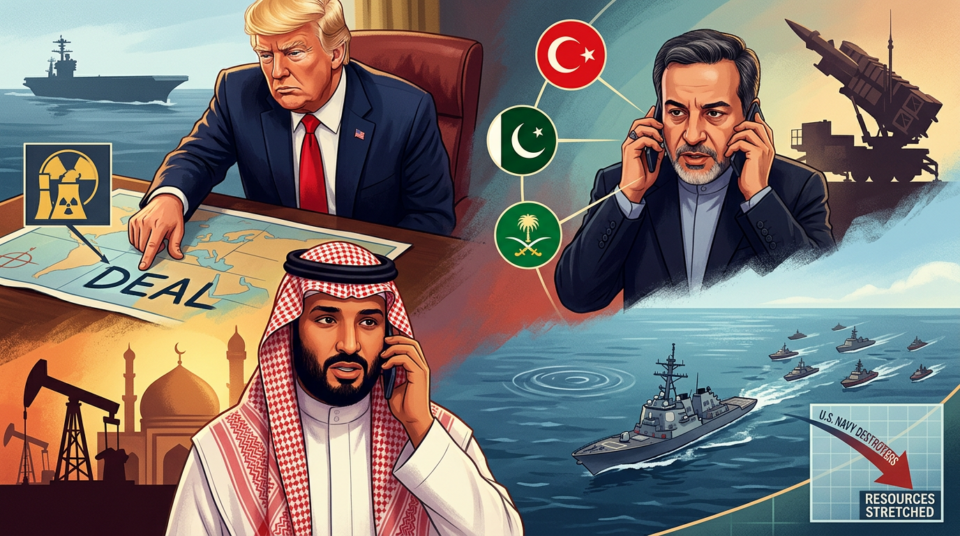
The ongoing conflict between the United States and Iran, which commenced on February 28, 2026, continues to impact regional stability and global oil prices. On August 3, 2026, US President Donald Trump announced that new negotiations with Iran are set to begin, following his decision to hold off on new strikes against the Islamic republic to pursue a deal. Trump confirmed that a plan for a major attack on Iran was cancelled at the request of Saudi Arabia, the UAE, Qatar, and Iran.
Latest development
Amidst rising tensions, a US military base in Kuwait has reportedly been hit. In response to the ongoing situation, Iran has issued a strong warning to the United States, asserting that it "won't back down" in the face of pressure.
Latest updates
Amidst rising tensions, a US military base in Kuwait has reportedly been hit. In response to the ongoing situation, Iran has issued a strong warning to the United States, asserting that it "won't back down" in the face of pressure.
President Donald Trump has warned Iran of a "devastating attack" if negotiations fail, stating that Iran faces "decapitation" if it does not strike a deal. He also reiterated that talks are ongoing.
President Donald Trump has declared that a US military blockade on Iran will continue until a “Deal, or Total surrender” is achieved. This statement came after Trump lashed out at Iran for denying it was in negotiations with the United States, calling the country “duplicitous.” Trump insisted that Iran had asked for talks but was now engaging in "their usual blather" about controlling the Strait of Hormuz, which he claimed is "completely controlled by the United States Navy." Pakistan News will update this story as more confirmed details become available.
Most stock markets in the Gulf ended higher on Monday, August 3, with the Dubai bourse outperforming the region. This came after US President Donald Trump announced he had paused a potential strike on Iran, raising hopes for a deal and the reopening of the Strait of Hormuz.
Dubai’s main share index advanced 1.4%, marking its biggest single-day gain since June 18. Top lender Emirates NBD jumped 3.3%, and sharia-compliant lender Dubai Islamic Bank finished 2.9% higher. In Abu Dhabi, the index added 0.3%, led by a 9.2% surge in Alpha Dhabi Holding. Saudi Arabia’s benchmark index rebounded from early losses to close 1.1% higher, with oil major Saudi Aramco gaining 2% and Jabal Omar Development surging 8.5%.
However, Iran stated on Monday that no talks with the United States were underway and no meetings were planned, contradicting President Trump’s claim that discussions would take place later that day. Shipping data on Monday also showed two Saudi oil tankers transited the Bab el-Mandeb Strait over the weekend, while traffic through the Strait of Hormuz slowed amid reports of vessel attacks.
US President Donald Trump stated that a plan for a major attack on Iran was cancelled at the request of Saudi Arabia, the UAE, Qatar, and Iran. President Trump added that if the attack had proceeded, it would have been the largest since World War II. He also noted that many Middle Eastern allies support a diplomatic solution over military action.
US President Donald Trump announced on Monday, August 3, 2026, that new negotiations with Iran are set to begin today. This development follows his decision to call off a planned attack against the Islamic republic to pursue a deal to end the conflict.
Oil prices fell sharply today, with West Texas Intermediate (WTI) crude settling at $79.87 per barrel, a decline of 5.67%, and Brent crude dropping to $83.57 per barrel, down 4.96%. This decline followed US President Donald Trump's announcement that proposed military action against Iran had been postponed and new negotiations would commence. Speaking to reporters, President Trump confirmed that important talks would be held on Monday afternoon, though he did not disclose the location, participants, or set a deadline for an agreement. He emphasized a preference for a diplomatic solution over military conflict, citing the significant loss of life associated with wars. Market analysts interpreted these developments as a sign that Middle East tensions could ease, reducing immediate concerns over disruptions to global oil supplies.
When a memorandum of understanding (MoU) intended to bring the Iran war to a formal close within sixty days was announced on June 14, the world, particularly Asian economies dependent on Gulf oil, breathed relief. The Strait of Hormuz, which had been largely shut to shipping since late February, seemed to be slowly reopening, and oil prices retreated from their crisis peaks. The damage the conflict had inflicted on Asian economies — on growth, household budgets, and government finances — appeared to be contained as the ceasefire, no matter how fragile, between the US and Iran spawned hopes of a lasting peace in the region.
However, barely a month into the ceasefire, fresh hostilities broke out between the US and Iran. Though Pakistan and other mediators have kept pushing both to return to the MoU — a 14-point framework under which Washington and Tehran agreed to halt hostilities and reopen Hormuz to shipping while working through the harder questions of sanctions, Iran’s nuclear programme, and regional security over a 60-day window —, they haven’t been able to stop the war as yet. Since its resumption last month, the war is no longer contained to two countries. It has pulled in other countries from the region, as well as armed militias.
The conflict has already spilled over to the Red Sea, where Yemen’s Iran-backed Houthis are targeting Saudi-flagged ships, and to the Caspian Sea, where Ukraine hit vessels carrying Iranian-linked military cargo. Riyadh has also stitched together a Multinational Maritime Defence Alliance, a 14-nation coalition announced on July 30, led by Saudi Arabia, alongside Turkey, Pakistan, and Egypt, to safeguard critical regional waterways. Global institutions like the International Monetary Fund and the World Bank have cut their growth forecasts, pointing to geopolitical uncertainty, tighter financial conditions, and inflation risk.
US President Donald Trump has announced the cancellation of planned attacks on Iran, stating that Iran and other regional countries requested this pause to facilitate a deal. This agreement reportedly includes the reopening of the Strait of Hormuz. Diplomatic interventions by Middle Eastern countries, particularly Saudi Arabia, are said to have urged restraint and encouraged a negotiated path forward. The latest pause in hostilities is seen as an opportunity for meaningful negotiations, with calls to adhere to the framework of the Islamabad memorandum of understanding.
US President Donald Trump announced that negotiations with Iran are scheduled to begin on Monday, August 3, 2026. This development follows his decision to hold off on new strikes against the Islamic republic in pursuit of a deal.
Reports indicate that Iran is setting "new red lines" concerning the Strait of Hormuz and its uranium program. Additionally, it is reported that Donald Trump sought help from Pakistan and Saudi Arabia amidst the ongoing tensions.
Since the conflict began on February 28, Donald Trump has exhibited shifting rhetoric regarding military action against Iran. On June 17, he praised Iran's new leaders as "very smart" and "far less radicalised," but by July 8, he referred to them as "scum." His public statements have included threats such as obliterating power plants on March 21 and a warning to wipe out a "whole civilisation" on April 7. However, he also extended deadlines for military action on March 23 and agreed to suspend bombing for two weeks on April 7 after discussions with leaders in Pakistan.
Amidst ongoing tensions between the United States and Iran, Saudi Arabia has reportedly formed a 15-nation alliance.
Mediators are actively working to revive the collapsed Islamabad agreement between Iran and the United States, which briefly halted hostilities in June and addressed critical issues like the Strait of Hormuz. An Iranian lawmaker, Hassan Ghashghavi, spokesman for parliament’s national security commission, confirmed on Sunday that efforts are underway to revive the 14-point Islamabad agreement, particularly by mediators. He stated that the main issue and key to the matter is the Strait of Hormuz, and there is an exchange of views. The original agreement, known as the Islamabad memorandum of understanding, was reached with the involvement of Qatar and Pakistan, with negotiating sessions held in Islamabad. It included arrangements concerning the Strait of Hormuz, a resumption of diplomacy, and a call for an end to hostilities in Lebanon. The deal later collapsed after both Iran and the United States accused each other of violating its provisions.
Iran's Mehr news agency has denied President Donald Trump's claim that Tehran asked the United States to refrain from conducting new strikes, calling the allegation a "new lie." Citing military officials, the agency stated that Iranian armed forces are "on high alert and ready for any eventuality."
Separately, Iran's Fars news agency, citing a source close to Iranian negotiators, said that the Strait of Hormuz would remain closed "as long as the United States maintains its hostile actions." Iran has reportedly blockaded the Strait since the conflict began, requiring vessels to obtain permission and pay transit fees.
Meanwhile, Kuwait's army reported destroying hostile drones launched by Iran against several vital facilities. Iranian Foreign Minister Abbas Araqchi, in phone calls with Turkish, Pakistani, and Saudi officials, discussed the consequences of "destabilising actions" by the US and prospects for heightened regional insecurity.
Latest Fact Checks
Trump tells Iranians to negotiate or surrender
WASHINGTON: President Donald Trump lashed out Monday after Iran denied it was in negotiations with the United States, declaring in an angry social media post that a US military blockade will continue until there is a “Deal, or Total surrender.” Calli
Most Gulf markets in black as Trump holds off Iran strike
Most stock markets in the Gulf ended higher on Monday, with the Dubai bourse outperforming the region, after U.S. President Donald Trump said he had paused a potential strike on Iran, raising hopes for a deal and reopening of the Strait of Hormuz. Th


Responses